
If budget were no object and your KPI was long-term impact, which would you choose: a Sydney pub or a Las Vegas convention hall?
Bigger is better. Right? It's the maxim that has defined B2B event success for as long as anyone can remember.
After all, who doesn't love a full room? Sponsors are happy, attendees enjoy the buzz, and the simple fact that hundreds or even thousands of people turned up is a success metric that's easy to communicate.
And when you ask why companies invest in events right now, the answer is increasingly ROI. Media coverage and my own conversations as a speaker and roundtable host make that clear: sponsors and sales execs aren't at big events for the love of the game.
But as I reflected on a life-changing small pub event I spoke at in Sydney this month, against trending news of a mind-boggling scale event in Las Vegas, it crystallised a growing sentiment among marketers and event strategists that size alone is an outdated metric.
Small Rooms vs Mega Rooms: what the data says
Let me step back for a moment.
The Story Code'sFive Future Worlds research has been running for the past few months. It tracks signals in editorial media coverage across key global markets to map current and emerging sentiment, using five lenses drawn from the Five Future Worlds narratives that can be applied to any sector. So far, the project tracks four:
Homing in on B2B events, the most newsworthy gap in Five Events Worlds is consistently between small events ('Small Rooms') and mega events ('Mega Rooms'): a David and Goliath battle for relevance.
Anecdotally, on the home front I'm hearing and seeing 2027 APAC plans with a definite leaning toward Small Rooms. One respected event organiser I spoke with casually referenced almost 300 roundtables of 8–10 guests on the 2027 roadmap.
When our first Five Events Worlds scan ran on 2 August, Mega Rooms led by 41 points (58% of the conversation versus 17%). Within three weeks, that lead had collapsed. Small Rooms edged ahead on 23 August and stayed in front for three straight weeks, peaking at 42% of coverage on 30 August and leading by 11 points by 6 September.
Then a run of record-breaking trade shows and big convention wins pushed Mega Rooms out to a 30-point lead (46% versus 16%) by 27 September, where it still sits comfortably in pole position in the latest scan.
A tale of two rooms: Las Vegas and a Sydney pub
This month, two events at opposite ends of the scale put real faces to those battling trendlines.
First, IMEX America 2026 grabbed event industry headlines. This granddaddy of trade shows for the global meetings, events and travel industry just set its own attendance record with more than 17,800 participants and 96,000 scheduled meetings at the Mandalay Bay Resort and Casino in Las Vegas.
That's an extraordinary top-line result (and a complete nightmare for introverts).
Contrast that with around 90 people, mostly men, gathered at a Sydney pub. That was me last week. I was in the speaker line-up of six men sharing often deeply personal stories on the theme of "lies we'd been telling ourselves" to mark Mental Health Month.
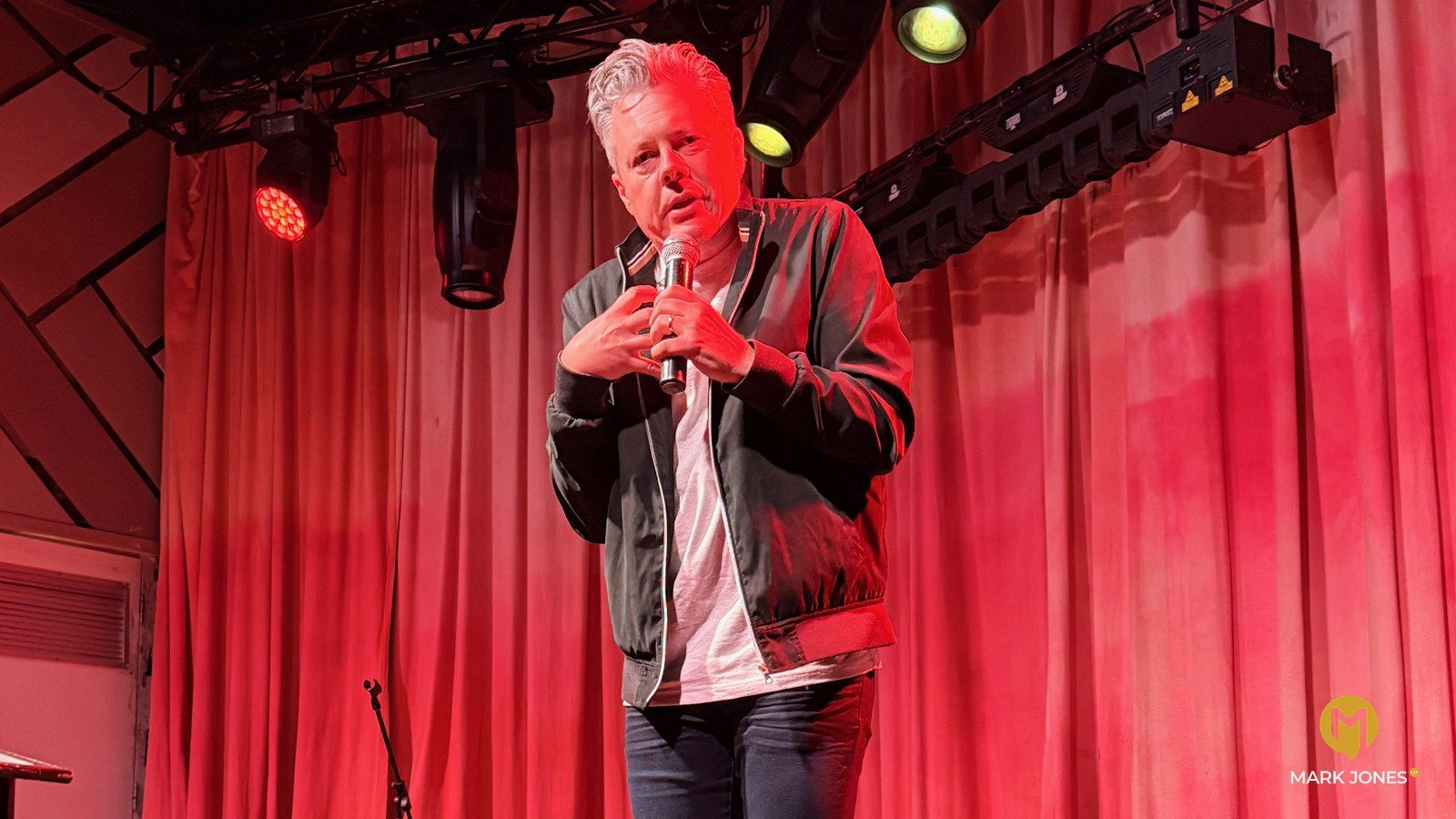
Called His Story, it's a regular storytelling event by men to inspire honest conversations, real connection and positive change across generations of men. Men talking about tough stuff while raising money for mental health charity Mongrels Men. What a way to close out Mental Health Month.
What's significant about the why behind this event is a very simple statistic. Beyond Blue says men account for seven of the nine daily deaths by suicide in Australia. Over a year, that's nearly double the national road toll.
Clearly that's not ok. We all shared a passion for doing something about this issue.
I got thinking about the purpose driving two events at such different scales – the record-breaking IMEX America 2026 and the small but mighty His Story gathering.
Two polar-opposite events, one central idea
Regardless of size, any event or marketing strategist should be curious about the golden thread that ties Mega Rooms and Small Rooms together. Once you see it, it should change how you design your 2027 events and budgets. It starts with a simple question: why do people come to events?
To borrow an idea from Priya Parker's seminal book, The Art of Gathering, the purpose of your gathering matters more than attendee numbers, format or location.
Through that lens, you could argue the primary purpose of a mega trade show-style event is serving the organiser more than its attendees.
As any event grows, the distance between organisers, key stakeholders and each individual attendee grows larger. And arguably, so does the human detachment from events that don't attend to the deep human need for connection, authenticity and a sense of belonging – all woven through invisible stories we're telling ourselves that drive behaviour.
To be clear, a more intimate connection between an event host and individual attendees isn't a hallmark of success in isolation. That's simply not possible at large-scale events.
But it's easy to get lost in the throng and feel like you don't really matter. And, critically, individual experiences usually remain invisible on any event report.
In a smaller room like His Story, that gap between organiser and attendee is non-existent. The founder, Tim Hewson, was on stage and everywhere around the room. His commitment to our shared why was unmistakable.
What can be scaled is laser-sharp focus on attendee benefit, clarity of purpose, and stories curated from within the community.
It reminds me of the adage that people won't remember what you said as much as how you made them feel – a useful reflection as we consider the correlation between event size and long-term impact.
The gap isn't the issue
As a journalist, I made putting my audience first a front-and-centre principle. I'd get 700 pitches from PR people a day at the Financial Review, and for every single one, my first question was: how or why does it matter to our readers? Most of the so-called 'news' was self-serving to whichever company was on the press release letterhead.
The life-changing impact on every guest at the His Story event that night came from stories rarely told and a level of vulnerability among men rarely seen in public.
We weren't "being brave" for the sake of it. It was to benefit others, as it should be.
Now, does that mean extreme examples like IMEX America lack purpose and audience focus? Of course not. In fact, they arguably mitigated the risk of scale with almost 100,000 (presumably smaller) meetings run in parallel.
But the risk with most big events is that the core purpose can drift or split into multiple competing purposes that start diluting its impact. The sheer scale of logistics, sponsor liaison, profit and loss, speaker quirks, insurance risk and fallible IT systems make focusing on "the one" objectively impossible.
By contrast, as a roundtable host, I know every single guest by name. I have a bio and background research on each one, I know their business, have spoken to the sponsor execs about known challenges, then join all those dots to identify universal topics and challenges. From there I can craft an editorial arc, directing questions to specific individuals whose answers will inevitably be to the benefit of all others.
Five questions to ask before your next event
So where to from here? Regardless of your event size or format, here's a list of questions you and your team might ask yourselves to satisfy the why question.
- Do we need this event at all?
- What's it for – really?
- Who is the most important stakeholder – really?
- What could change to serve others better?
- What blocks us staying focused on our purpose?
Start with the audience
The golden thread in any event is the audience – by definition, every event needs one! So their experience must be the dominant weave in any event success story. It's a lesson I've learned many times over in journalism and publishing. Without them, you don't exist.
So, in a world where meaning, purpose and the deep why driving our gatherings matter more than ever, it's the perfect time to be rethinking what event success looks, feels, sounds and tastes like – be it a cold beer or a corporate canapé. When the story starts with your audience, trust me, it's a whole lot easier to write.


